
How to Find Reliable Manufacturers in Türkiye: A Practical Playbook for EU and UK Buyers
Verification Guides
How to Find Reliable Manufacturers in Türkiye: A Practical Playbook for EU and UK Buyers
For EU and UK procurement teams, how to find reliable manufacturers in Türkiye is no longer a side question—it’s a core sourcing strategy. Türkiye offers competitive pricing, shorter lead times than Asia, and tariff advantages into the EU and UK. But the market is fragmented, information is opaque, and choosing the wrong supplier can cost hundreds of thousands of euros in delays, quality claims, and reputational damage.
This playbook walks you step by step through how to identify, shortlist, and validate Turkish manufacturers—using practical checks, real-world benchmarks, and third-party support where it matters.
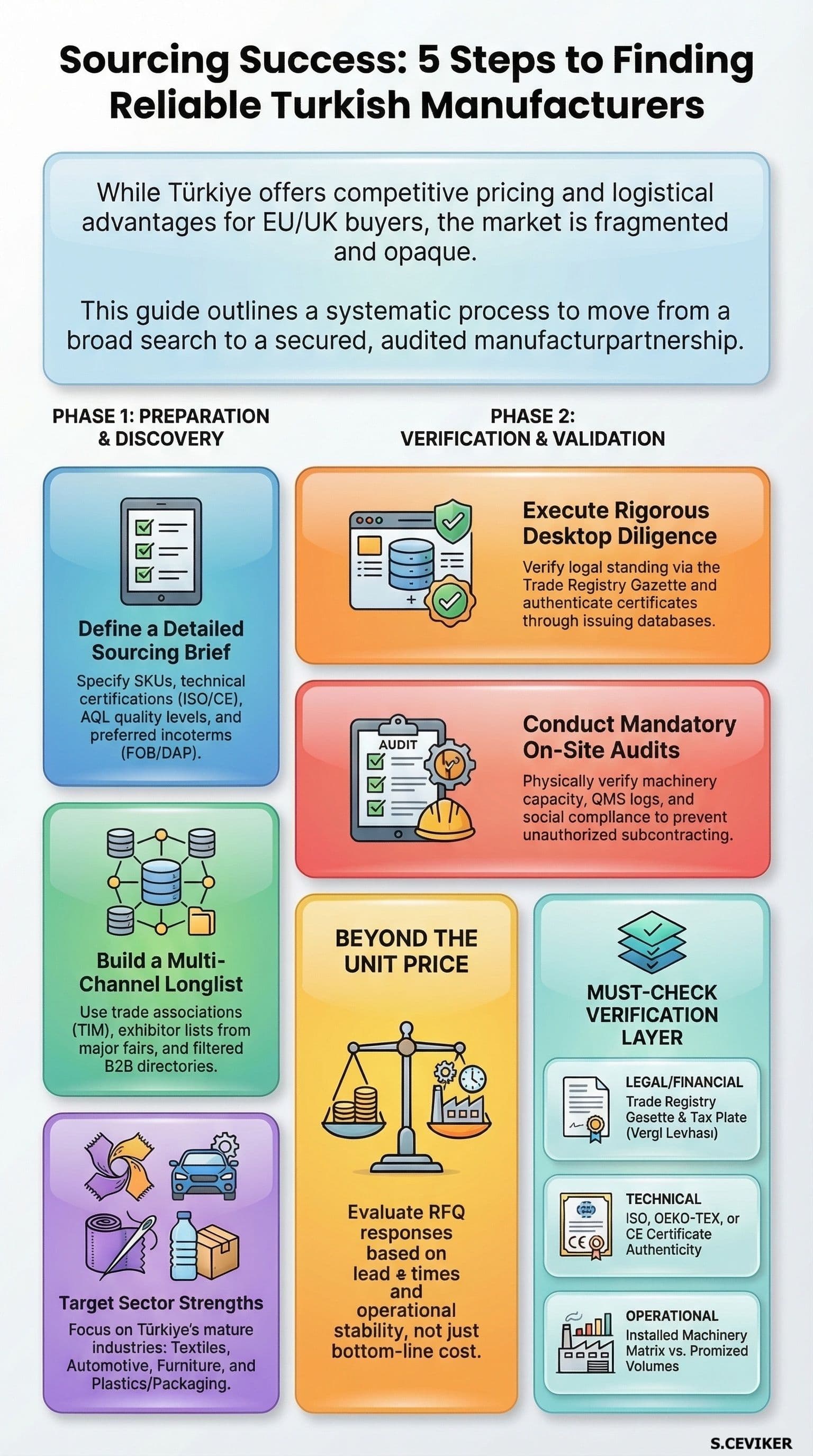
1. Start with a clear sourcing brief (and Türkiye-specific constraints)
Before you start searching for suppliers, define a sourcing brief that reflects both your internal requirements and the realities of Turkish manufacturing.
Clarify your must-haves:
- Product scope: SKUs, variants, annual volumes, ramp-up plan (e.g., 50,000 units in year 1, 150,000 in year 2).
- Technical specs: Materials, tolerances, certifications (e.g., OEKO-TEX, ISO 9001, IATF 16949, FSC, CE, REACH, RoHS).
- Quality standards: AQL levels, testing protocols, documentation required (CoA, CoC, PPAP, etc.).
- Commercial terms: Target price ranges, Incoterms (EXW, FOB, FCA, DAP), payment terms (e.g., 30/70, LC at sight, 60 days after B/L).
- Logistics expectations: Lead times, minimum order quantities (MOQs), preferred ports (Istanbul, Izmir, Mersin), or road routes into the EU.
Adapt to Türkiye’s strengths:
Türkiye is particularly strong in:
- Textiles & apparel: Fast fashion, home textiles, technical textiles.
- Automotive & metalworking: Machined parts, stampings, assemblies.
- Furniture & wood products: Flat-pack, contract furniture, shopfitting.
- Plastics & packaging: Injection molding, blow molding, flexible packaging.
Align your brief with sectors where Türkiye already has scale and export experience. You’ll find more mature suppliers, better English skills, and more predictable quality.
2. Build a longlist using multiple, verifiable data sources
Relying on a single platform or a quick Google search is one of the fastest ways to miss good suppliers—or end up with trading companies instead of factories.
Use at least three of the following channels to build a longlist of 20–50 potential manufacturers:
Official export and trade databases
- Turkish Exporters Assembly (TIM) and sectoral exporter associations often list member companies by product category.
- Cross-check whether the company’s export volumes and markets match your needs (e.g., already exporting to Germany or the UK).
Trade fairs and virtual exhibitor lists
Look at exhibitor lists from fairs in Istanbul and major EU shows, for example:
- Textile: ITM, Texworld, Heimtextil.
- Automotive/metal: Automechanika Istanbul, WIN Eurasia.
- Furniture: Istanbul Furniture Fair (IIFF), Interzum.
Exhibitors that invest in trade fairs usually have export experience and some level of compliance.
B2B platforms (with filters and skepticism)
Use platforms like Turkish exporter directories or global B2B marketplaces, but:
- Filter by manufacturer/producer only.
- Check if the address is an industrial zone (OSB) rather than a city center office—this is a quick proxy for real production.
3. Execute Rigorous Desktop Verification (The Shortlisting Phase)
Once you have a longlist, reduce it to 3–5 highly qualified candidates through systematic data validation. Relying on self-reported data introduces severe supply chain risks.
- Legal Validation: Cross-reference company details in the Turkish Trade Registry Gazette (Ticaret Sicil Gazetesi) to confirm ownership structure, registered capital, and legal standing.
- Financial Health: Request the latest tax plate (Vergi Levhası) and audited financial statements to assess operational stability.
- Certificate Authentication: Do not accept PDF documents at face value. Validate ISO, CE, FSC, or OEKO-TEX certificate numbers directly through the issuing authority's database (e.g., TÜV, SGS, Intertek).
4. Initiate the RFQ Process and Measure Operational Metrics
Deploy the Request for Quotation (RFQ) to the shortlisted suppliers. Evaluate responses based on quantifiable metrics, not just the bottom-line unit cost.
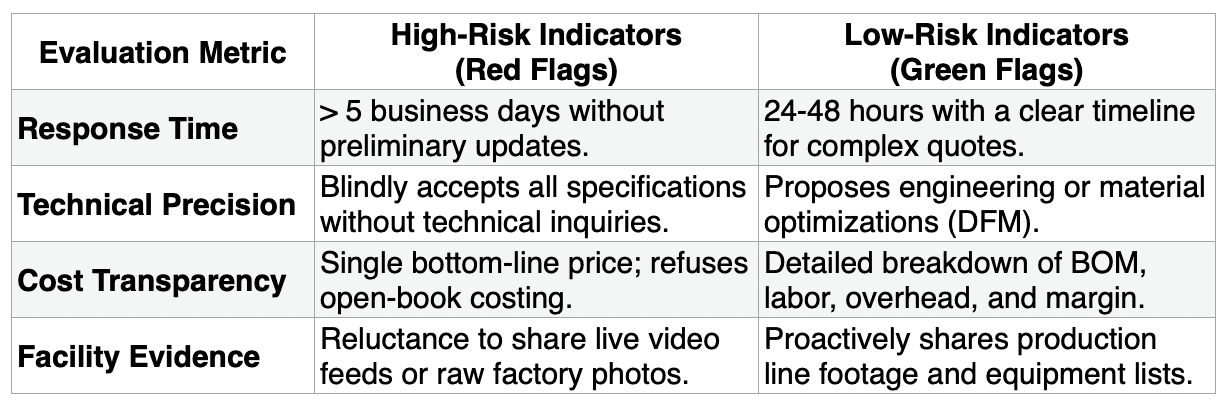
5. Mandate On-Site Audits (Ground Truth Verification)
Desktop verification cannot detect unauthorized subcontracting or phantom factories. Physical auditing is a non-negotiable step before finalizing any strategic procurement contract in Türkiye.
- Machinery & Capacity Assessment: Verify that the installed equipment matrix aligns mathematically with the promised Lead Times and annual volumes.
- Quality Management System (QMS): Inspect incoming material quarantine zones, in-line testing stations, and final Outgoing Quality Control (OQC) logs.
- Social Compliance: Evaluate adherence to labor laws, occupational health and safety (OHS) standards, and environmental regulations to prevent reputational damage in EU/UK markets.
Secure Your Supply Chain in Türkiye
Identifying a supplier on a directory is only the baseline; verifying their operational reality requires localized engineering and auditing expertise. Information asymmetry in the Turkish manufacturing sector frequently leads to compromised quality, delayed shipments, and financial losses for unverified overseas buyers.
Do not risk your procurement budget on unverified data. We provide objective, on-the-ground supplier verification, technical audits, and commercial due diligence across Türkiye.
Schedule a Consultation / Contact Us Today to deploy our local experts to your potential supplier's factory floor and secure your supply chain.

